Black History Month Spotlight:
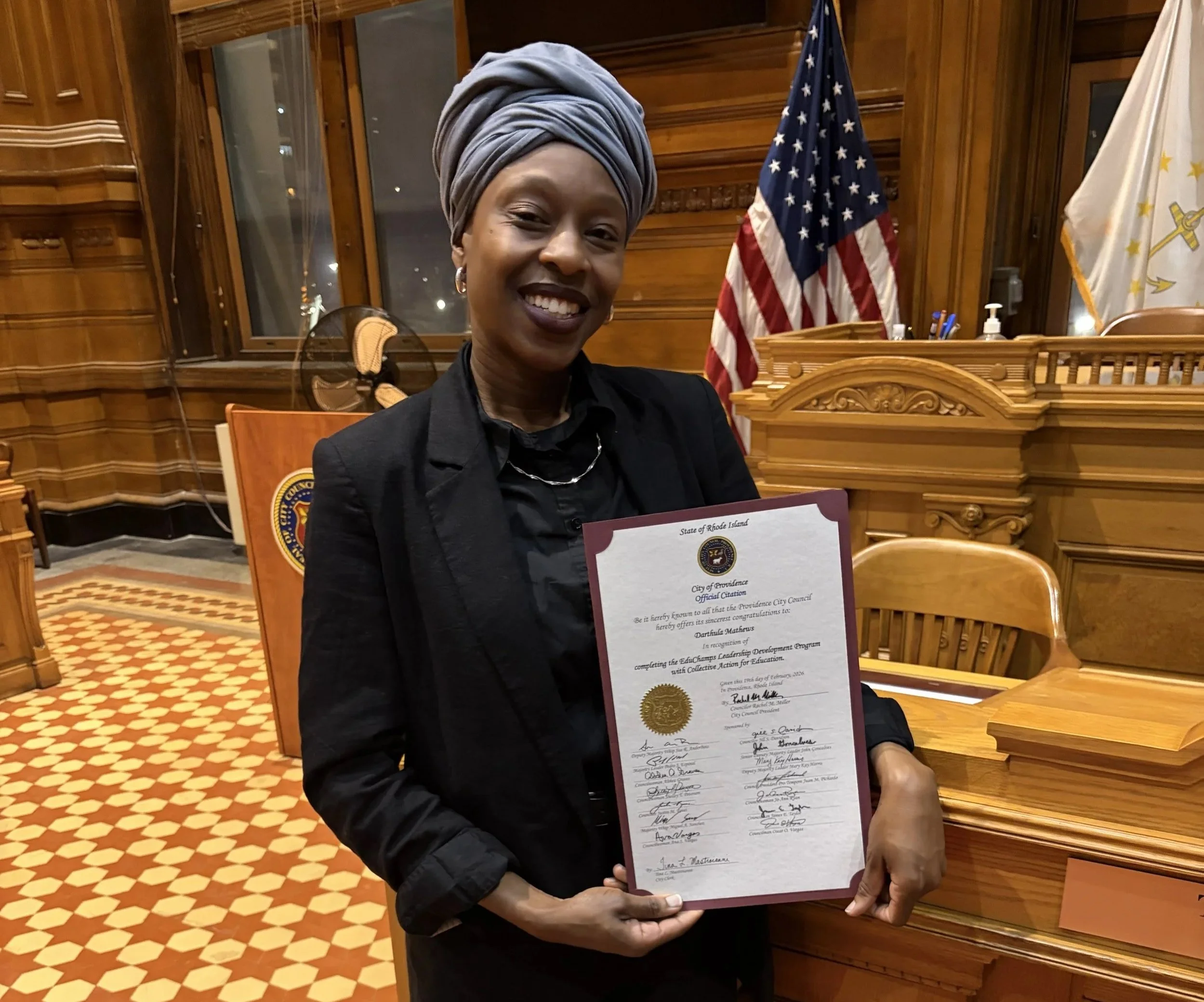
Meet Darthula Mathews
In honor of Black History Month, we are proud to feature Darthula, an educator, coach, and community leader whose work centers equity, truth, and collective learning. A member of Collective Action for Education’s inaugural EduChamps cohort, Darthula brings a deep commitment to student- and community-centered leadership through her work with Great Schools Partnership, her board service with youth- and history-focused organizations, and her belief that education extends far beyond the classroom. In the reflections below, she shares her journey, the educators who shaped her path, and the ancestral wisdom guiding her leadership today.
-
My name is Darthula. My father gifted me as the namesake of his aunt, my great Aunt Tula. I have come to learn my name means a woman of wisdom and beauty, and I will honor these attributes of my family's legacy. I have the honor of working in the education space with Great Schools Partnership as a coach, where I support educational equity initiatives from the state level down to the student level. The scope of our work includes strategic planning, culture and community, and teaching and learning throughout New England. My projects within these areas include diversifying the educator workforce and strengthening instructional practices with culturally responsive pedagogy, trauma-informed practices, social-emotional learning, and restorative practices.
I am also deeply involved in student/youth-centered education and community-based work across Rhode Island. Currently, I serve on two boards. As board President ofA Leadership Journey, I support the mission to “To EMPOWER and EQUIP youth ages 13-18 from marginalized identities to serve and see themselves as global citizens.” Programming includes but is not limited to the August-MayEducational Leadership Program and the 2 week longUbuntu program. As a general board member ofThe Newport Middle Passage, I uphold the mission “To honor the lives of the captive Africans who perished in the Middle Passage journey and the Slave Trade, and to celebrate the economic and cultural contributions of the survivors and their descendants, who helped build Newport and America.” There, I sit on the fundraising and education subcommittees, helping to uplift Rhode Island’s history through a lens of truth, joy, and collective learning.
Education, for me, has never been confined to a school building or a four-walled classroom. Learning is constant. It happens everywhere intentionally or unintentionally for better or for worse. Because of that, I feel a deep responsibility to model and cultivate healthy, expansive learning environments within my own family and community.
As a parent, I have been intentional about engaging my children in real-world learning spaces across our state, region, and country whenever possible. I do not just want them to consume information. I want us to grow together. That has meant immersing ourselves in library and community events, historical tours, and learning labs at colleges and universities. It has meant treating everyday life skills as meaningful sites of knowledge-building rather than routine obligations.
One of my favorite shared learning experiences came from applying the wisdom of Farming While Black by Leah Penniman. After reading it, we brought the text to life by volunteering together at Soul Fire Farm during a Community Work & Learn Day. What began as reading became practice as we tended to the wet soil on our hands in the rain, collective labor, and embodied understanding. It transformed knowledge into lived experience.
That level of learning matters. It reminds us that education is not passive, isolated, or individual as it is active, communal, and liberatory. Access to knowledge and opportunity should not be occasional or exclusive; it should be constant and collective.
When we approach learning as a shared responsibility and a shared right, we cultivate not just informed individuals, but empowered communities.
-
Outside of my parents and immediate family, the first Black educator who made a lasting impact on my life, and who I continue to hold close to my heart, is Ms. Diakite. Thanks to Josh Laplante, I recently had the opportunity to reconnect with her, and I was overjoyed to learn that she is still serving in education, now leading as a principal.
As a member of the Global Majority in this profession, it means more than I can fully express to see her not only remain in the education space, but thrive in it. Too often, educators who look like us are pushed out rather than supported. Seeing her continue to lead is both affirmation and inspiration.
Ms. Diakite was my middle school advisor and, if memory serves, my social studies teacher as well. There is a moment from her class that remains vivid in my mind. We were reading about enslaved people, and the textbook offered only a brief, surface-level acknowledgment of their lives and experiences. I remember questioning why that was all there was to say. Ms. Diakite didn’t need to respond with words as her expression alone told me she understood exactly what I was feeling. In that moment, I felt seen. I felt protected. I felt affirmed. That experience taught me something enduring: representation in education is not symbolic—it is transformative. It creates space for truth. It creates space for inquiry. It creates space for students to trust their instincts and name what feels incomplete or unjust.
I was also deeply influenced by Ms. Jackson, my middle school English teacher, who nurtured my love for literature and language. Through her classroom, I discovered that stories are not just assignments, they are mirrors, windows, and doors. Together, these educators shaped my understanding of learning as something powerful, identity-affirming, and liberatory.
Their impact continues to guide how I show up today. I remain committed to equity and representation not as abstract ideals, but as daily practices. I believe students deserve to feel seen, valued, and intellectually challenged. They deserve classrooms where their questions are honored and where they are positioned not merely as participants, but as co-leaders in their own learning. The seeds Ms. Diakite and Ms. Jackson planted continue to grow in me. And in my own work, I strive to plant seeds just as intentionally.
-
For Black students who are thinking about leadership and community service, my first piece of advice not just for this month but for the rest of the year and life is this: you don’t need to follow in anyone else’s footsteps, you need to learn how to walk in your own.
It begins with knowing yourself deeply and honestly. Take the time to understand who you are beneath the noise. Learn how you think, how you learn, what restores you, and what drains you. Pay attention to what moves your spirit and what misaligns you. Self-knowledge is not indulgent; it is foundational. When you understand yourself, you move with intention instead of imitation. But don’t stop there. Turn that same curiosity outward. Learn your people. Learn your communities. Seek out the real history. The kind that tells the truth about systems of influence and power: where it has been concentrated, where it has been withheld, and how it continues to shape our present. When you confront those truths, your vision sharpens. You begin to see not only the world as it is, but the role you are called to play within it.
Ancestral wisdom reminds us that leadership is not just about picking up a baton but also about planting seeds. Some of those seeds we may never see bloom. Yet we plant them anyway, with faith that they will grow. That is the courage of generational thinking. That is the discipline of legacy. When you truly know yourself, and remain sincerely curious about others, you lead differently. You lead in ways that are human. Restorative. Rooted in community rather than ego. You understand that leadership is not dominance; it is stewardship.
And read. Constantly. Sit with the autobiographies and works of voices like James Baldwin, Toni Morrison, Angela Davis, and Viola Davis. Read stories of our shared experience told in our own voices. Reading deepens your understanding. It sharpens your discernment. It connects you to the wisdom, resilience, and brilliance of those who walked before you. Knowledge is more than information, it is inheritance. And when you carry it well, it becomes guidance. Young people, the world does not need you to be a copy of what has already been. It needs the clarity, courage, and compassion that only you can bring. Do the inner work. Seek the deeper truth. Stay curious. Plant seeds.
Then step forward grounded, aware, and ready to cultivate something meaningful that only you can give the world